Showing posts with label historical fiction. Show all posts

Saturday, September 19, 2015

The Curious World of Calpurnia Tate


This is a sequel to The Evolution of Calpurnia Tate, Jacqueline Kelly's 2010 Newbery Honor Book, but you don't need to have read it in order to enjoy this one.

It takes up right where the previous book left off - the beginning of the year 1900, in the Tate home in Fentress, Texas.  Twelve-year-old Calpurnia Virginia ("Callie Vee") Tate, the middle child among six brothers, is thrilled to find it snowing - a rarity in Central Texas in the winter.

This book continues the Darwinian theme with epigraphs for each chapter from Charles Darwin's The Voyage of the Beagle.  Fitting, too, because this time, Callie's scientific explorations - mostly conducted with her grandfather - focus on animals instead of plants, as well as the weather and stars.

Callie's younger brother Travis (all but the oldest brother are named for various early Texas heroes) plays a big part in this book, with his quest to find the ideal pet.  He adopts a series of inappropriate ones - an armadillo, a blue jay, a raccoon - and finally a half-coyote dog he names Scruffy. Callie's involved in (trying to) help him keep them hidden from their parents, and in caring for them when they are ultimately discovered.

In an interview, Kelly said she'd wanted to write a sequel,  "but our big old house in Fentress, Texas, which served as the inspiration for so much of the first book, was struck by lightning and burned to the ground in 2010.  It was a horrible experience and it took me some time to get over it."  She also said she "drew a lot of inspiration from our dog Laika, a stray living near the San Marcos River, who we are pretty sure is half-Chow and half-coyote." Laika is the inspiration for Scruffy.

Kelly, who lived for a while in Galveston, works the 1900 hurricane that devastated that city into the story. Callie sees a coastal gull that's flown far inland, and her grandfather has her build a homemade barometer and make observations.  They predict the big storm and try to warn their family in Galveston.  After the storm, Callie's father and oldest brother go to help, and return with Callie's older cousin Agatha who comes to live with the Tates for a while - getting the bed in Callie's room while our heroine sleeps on the floor - while her family home is being rebuilt.  They are accompanied by a veterinarian who sets up practice in Fentress.  Callie assists him with some of his patients, and is frustrated by 1900s customs that would seem to prevent her from becoming a veterinarian herself.

The gentle reminders that girls didn't have the kinds of opportunities in the early 1900s that they do today, plus Callie's interest in science, encouraged by her grandfather (she even dissects a worm and a frog, and builds an astrolabe to learn about latitude and longitude), make this book especially appropriate for girls age 11 and up, as well as "all nature lovers, and all curious kids, and all strong readers," according to Kelly.

Once again, the beautiful silhouette on the cover was designed by the talented Beth White.  And native Texan Natalie Ross also reads this audiobook, with her soft but musical Southern-accented voice, perfect for Callie, who tells her own tale.


© Amanda Pape - 2015

[The Curious World of Calpurnia Tate is available on the lower level of the Dick Smith Library in the Curriculum Collection, call number EDUC PZ7 .K296184 CU 2015.  The audiobook is also available in the Audiovisual Collection on the lower level, call number AV-AUDIO PZ7 .K296184 CU 2015B.]

Tuesday, September 1, 2015

2010 Scott O'Dell Award

The Storm in the Barn, a graphic novel written and illustrated by Matt Phelan, won the 2010 Scott O'Dell Award for Historical Fiction written for children or young adults.  It was also a Texas Bluebonnet Award nominee in 2011-2012.

It's set in Dust Bowl Kansas in 1937, and it hasn't rained in four years, since now-11-year-old Jack would have been old enough to help around on the family farm.  Since there's no farming possible, Jack's father seems to perceive Jack as being useless.  Being picked on by the town bullies doesn't help.  The general store owner tells him stories of Jacks of folklore to bolster him.  His sister Dorothy suffers from dust pneumonia, and it seems the only bright spot is when she reads aloud from some of Frank Baum's Oz books. Like Oz, the only illustrations in the book that are not monochrome occur when Jack's mother reminisces about the past.

Otherwise, Phelan's pencil, ink, and watercolor drawings use muted tones, browns and beiges in the daytime, and blues and grays at night, inside the barn, and during the rain that finally comes.  In an author's note at the end, Phelan says some of his inspiration was the black-and-white images of Works Progress Administration photographers of the era such as Dorothea Lange and Walker Evans.  He wrote,  "I began to imagine what the experience of living in the Dust Bowl must have been like through the eyes of a kid. Without the complicated explanation of the history of over-planting, soil erosion, and other factors, a young boy or girl would only know ... The rain had gone away. But where?"

While graphic novels are often good for struggling readers, the sparseness of the text in this story might be difficult for some.  It was difficult to interpret what was going on in a few of the textless panel sequences.  For this reason - and because of a (thankfully not-too-graphic) section about killing off jackrabbits that were overwhelming the area - this book would be best for somewhat older readers, age 11 and up.  The fantasy element in the book (the "storm in the barn" pictured on the cover), might make it more appealing for children.


© Amanda Pape - 2015

[The Storm in the Barn is available on the lower level of the Dick Smith Library in the Curriculum Collection, call number EDUC PZ7.7 .P485 ST 2009.]

Monday, August 31, 2015

1958 Newbery Medalist

Rifles for Watie won the Newbery Medal for "the most distinguished contribution to American literature for children" in 1958.  Unlike most Civil War novels, it is set on the western front, specifically in (what is now) Oklahoma, Kansas, Missouri, and Arkansas.

Jefferson Davis "Jeff" Bussey is sixteen-year-old farm boy in Linn County, Kansas, when the war begins in 1861.  Inspired by his admiration for Abraham Lincoln and an attack on his family by pro-slavery Missouri bushwhackers, he joins the Kansas Volunteers at Fort Leavenworth.

Jeff is eager to see battle, but has only a background role initially.  Later he learns the harsh realities of combat, moves from the infantry, to an emergency participation in the artillery, to the cavalry, and becomes a scout.  His time "undercover" on the Confederate side was one of the most interesting parts of the book.  He learns that the Rebels are people just like him, and when he falls in love with a Confederate Cherokee girl, he feels torn between the two sides.

This book held the interest of a non-fan of war fiction throughout.  It's well-written and provides much insight into the day-to-day life of soldiers in the Civil War's western front.  The reading level and content of this book makes it more appropriate for grade six and up.

Author Harold Keith, a native Oklahoman who had a master's degree in history, interviewed 22 Confederate veterans then living in Oklahoma and Arkansas as part of his research for the book.  He also read diaries and journals of mostly Union veterans, and hundreds of letters, including many from the mixed-blood Cherokees who participated in the war, such as family members of the Confederate general Stand Watie of the title (although there is no evidence Watie ever attempted to get the repeating rifles of the title and the fictional plot).


© Amanda Pape - 2015

[Rifles for Watie is available on the lower level of the Dick Smith Library in the Curriculum Collection, call number EDUC PZ7 .K255 RI 1957.]

Tuesday, July 1, 2014

The Evolution of Calpurnia Tate

It's 1899, and almost-12-year-old Calpurnia Virginia ("Callie Vee") Tate is growing up as the middle of seven children (and only daughter) of a wealthy cotton and pecan farmer and gin owner in Fentress, Texas.  She's a bit of a tomboy, and would rather accompany her retired grandfather on his expeditions to study plants and wildlife than learn to play the piano, cook, or sew, all expected of a girl of that age and time.  She even helps her grandfather in his experiments to make an alcoholic beverage with pecans, and in identifying what they hope is a new species of vetch, a common plant in Texas.

The book starts in the summer of 1899 and ends as 1900 begins.  The reader experiences everyday life with Callie's large and active family, as well as special occasions such as holidays, the county fair and a trip into town for a photograph.  These feel authentic to the time period.

This book was a Newbery Honor Book in 2010 (for the "most distinguished contribution to American literature for children,") and I can see why.  I loved it!  The developing relationship with her previously-remote grandfather is wonderful.  I found it amusing that five of Callie's six brothers are named for early Texas heroes--Sam Houston, (Mirabeau) Lamar, (William B.) Travis, Sul Ross, and Jim Bowie--and she has interesting (and funny!) interactions with most of them, particularly her oldest brother Harry (named for a rich bachelor great uncle).  Even her exasperated mother and the overworked family cook, Viola, are rendered vividly.

I also liked the emphasis on the scientific method (particularly recording your observations), and the way debut author Jacqueline Kelly worked new inventions into the story - the telephone, the automobile, and even an early motorized fan (much appreciated in the Texas heat!).  I felt she did a fine job with the Texas setting.  Born in New Zealand, growing up in the rain forest of western Canada, moving to El Paso, Texas, in high school, and later living in Galveston, Austin, and Fentress, she seems to have a true appreciation for my home state, and got a lot of details right, adding to the story.  In a 2009 interview on Cynsations, Kelly said,

The book was inspired by my huge 140-year-old Victorian farm house in Fentress, a tiny community on the San Marcos River. I bought the house some years ago and promptly ran out of money to fix it up. The house is grand but falling down around my ears. One summer, I was lying on the daybed in the living room under the ancient air conditioner, which was barely cooling the room, and I thought to myself, how did people stand it in the heat a hundred years ago, especially the women, who had to wear corsets and all those layers of clothing? And with that thought, Calpurnia and her whole family sprang to life to answer the question for me.
Sadly, "the house was struck by lightning and burned to the ground" in 2010, according to Kelly in a later interview, which could have something to do with why a planned sequel hasn't materialized.

The language in this book is beautiful.  The descriptions of the natural world are detailed and evocative.  In the Cynsations interview, Kelly (who has both medical--which may explain those descriptions--and law degrees) said,

A friend of mine, a very successful trial attorney, once said, "Every lawyer I know has got a novel hidden away in his laptop somewhere." I think it's because we all love language, and using it to convey precise ideas. Or maybe it's because so many lawyers were English majors who couldn't then figure out what to do with their degrees.

Kelly begins each chapter with a quote from Charles Darwin's The Origin of Species, which Calpurnia's grandfather gives to her to read early in the story (hence the title of the book). The cover art is a lovely and intricate silhouette cut by Beth White.  The narrator of the audiobook is Natalie Ross, a native Texan, who makes a perfect adult Calpurnia looking back at that half-year and telling her own story.  This will definitely be a book I'll re-read.  I think it will also appeal to avid young female readers ages 11 and up.

© Amanda Pape - 2014

[The Evolution of Calpurnia Tate is available on the lower level of the Dick Smith Library, in print in the Curriculum Collection, call number EDUC PZ7 .K296184 EVO 2009, and  in the Audiovisual Collection, call number AV-Audio PZ7 .K296184 EVO 2009B.]  

Saturday, February 9, 2013

2002 Newbery Medalist

A Single Shard, by Linda Sue Park, is set in Korea in the 12th century.  Orphan Tree-ear lives under a bridge with another beggar, an older cripple called Crane-man.  Tree-ear admires the work of the famous local potter, Min, and when he accidentally damages some of his pottery, he must go to work for him.  Tree-ear volunteers to take a sample of Min's work to be considered for a royal commission, a long and arduous journey by foot.
This seemingly-simple story is full of lovely imagery and characters to care about.  Here's an example of the former:

Once...he had watched the potter place a plum branch in a finished vase to judge the effect.

The gentle curves of the vase, its mysterious green color. The sharp angle of the plum twigs, their blackness stark amid the airy white blossoms. The work of a human, the work of nature; clay from the earth, a branch from the sky. (p. 52)

There's even a discussion of intellectual property rights:
Tree-ear spoke slowly. "It is a question about stealing." He paused, starting to speak, stopped again. Finally, "Is it stealing to take from another something that cannot be held in your hands?"

"Ah! Not a mere question but a riddle-question, at that. What is this thing that cannot be held?"

"A - an idea. A way of doing something."

"A better way than others now use."

"Yes. A new way, one that could lead to great honor."

Crane-man lay back down again. He was silent for so long that Tree-ear thought that he had fallen asleep. Tree-ear sighed and lay down himself, thinking, thinking....

...And therein lived the question-demon: If Tree-ear were to tell Min what he had seen, would that be stealing Kang's idea?

Crane-man's voice startled Tree-ear.

"If a man is keeping an idea to himself, and that idea is taken by stealth or trickery - I say it is stealing. But once a man has revealed his idea to others, it is no longer his alone. It belongs to the world. (p. 62, 64).
(Although I have to admit, I felt some sympathy for poor Kang.)


In an interview in a teacher's edition of this book, Park said "three ideas - the pottery, family, and journey - are the basic threads of the story."  Research on Korea for her earlier books showed "that in the eleventh and twelfth centuries, Korea had produced the finest pottery in the world, better than even China's, and I decided to set my third novel in that time period," according to her Newbery acceptance speech.*

According to the interview, "the idea of family...is crucial to Korean society:  I made Tree-ear an orphan because I wanted to explore what family means to someone who has no blood relations....

I also wanted to write an adventure story because I loved reading them when I was young, and still do! I love traveling...So I knew right at the start that I wanted Tree-ear to go on an exciting journey."  And, according to her Newbery speech, her son, an admirer of Newbery Honor Book Hatchet by Gary Paulsen, "wanted me to write an adventure story, a road book."

In her author’s note at the end of the book, Linda Sue Park writes, “Every piece described in the book actually exists in a museum or private collection somewhere in the world.”  Her website has some photos of celadon work and other items and locations that are mentioned in the book (spoiler alert), including the Thousand Cranes Vase (pictured below left). More on Goryeo dynasty (918–1392) celadon can be found on the New York Metropolitan Museum of Art's website.

I thought it was interesting that in her Newbery acceptance speech, Park, who is of Korean heritage but only visited the country as a child, thanks Simon Winchester, author of the bestseller The Professor and the Madman, about the making of the Oxford English Dictionary, for his descriptions in his earlier book Korea: A Walk through the Land of Miracles, as his 1987 walk went on the route from Puyo almost all the way to Songdo.

She also credits 1966 Newbery Medalist I, Juan de Pareja, by Elizabeth Borton de Trevino.  "In that book, the orphaned black slave Juan de Pareja becomes an assistant to the painter Velazquez and is eventually freed by his master, which enables him to pursue his own painting career. The ending speculates on how a certain Velazquez work came to be painted, just as [A Single] Shard speculates about that [Thousand Cranes] vase."

This is a quiet book that might take more than one reading to be fully appreciated (it did for me).  Kids probably won't pick it up on their own (the cover pictured above or at right don't help; a newer cover pictured below right is at least more attractive).  However, it would be a good addition to a study of Korea or Asia or pottery.

Graeme Malcolm is alright as the audiobook narrator, but I found his British accent - especially his pronunciation of "ate" as "et" - distracting.

© Amanda Pape - 2012

[A Single Shard is available on the lower level of the Dick Smith Library, in print in the Curriculum Collection (call number EDUC PZ7 .P22115 SIN 2002 ), and as an audiobook in the Audiovisual Collection (pictured at the top of this post, AV-AUDIO PZ7 .P22115 SIN 2002 ). A variation of this review also appears on my blog, Bookin' It.]


*Park, Linda, "Newbery Medal Acceptance," Horn Book Magazine, July/August 2002, Vol. 78, Issue 4, pages 377-384.]
Thousand Cranes Vase  / CC BY-SA 3.0
Latest cover of A Single Shard

Monday, December 31, 2012

1961 Newbery Medalist

This is a survival and adventure story.  The tribe of twelve-year-old Karana is moved off its "Island of the Blue Dolphins" (the most remote of the Channel Islands off California, San Nicolas).  Karana leaps off the ship to get her younger brother, who has been left behind.  He dies soon after, and she spends 18 years alone on the island.   Karana makes weapons and hunts, builds a shelter of whale bones and a canoe, fights wild dogs, and explores the island.  There's also a lot of information about the animals of the island and surrounding ocean, such as sea elephants and otter.

Author Scott O'Dell's note at the end of the book states that Karana is based on a real person, the Lone Woman of San Nicolas Island, later baptized Juana Maria, who lived alone on the island from 1835 to 1853.   According to his website, O'Dell came across her story while researching his 1957 adult book, Country of the Sun: Southern California, An Informal Guide.   More information about the Lone Woman was uncovered in the late 1970s and early 1980s, and in 2012, a Navy archaeologist found a cave on San Nicolas that may have been hers. 

O'Dell, obviously, wrote his book before much of this information became available, and it was likely based on the prevailing legends of the time.  A number of these stories were published in popular magazines in the late 1800s and early 1900s.  The Lone Woman was unable to communicate with anyone, so no one really knows how she ended up on the island alone, especially since she died of dysentery only a few weeks after her rescue.

In 1976, O'Dell wrote a sequel, Zia, about Karana's 14-year-old niece by that name, who believes her aunt is still alive, and helps bring about her rescue by George Nidever.

Island of the Blue Dolphins has come under some criticism over the years, for stereotyping of native Americans.  On the other hand, it's also been praised for having a female minority protagonist (at a time, 1960, when that was not common), and for its environmentalist message.  "Island of the Blue Dolphins," O'Dell wrote, "began in anger, anger at the hunters who invade the mountains where I live and who slaughter everything that creeps or walks or flies."

Native American actress Tantoo Cardinal's reading of the audiobook is lovely.  However, this is a book that might be better "read" in print, to appreciate its beautiful metaphors and imagery.

The Dick Smith Library has three print copies of this novel, all different editions.  One (pictured at right) has twelve full-page watercolor paintings (and the cover) by Ted Lewin, illustrator of more than 100 children's books.

© Amanda Pape - 2012

[Island of the Blue Dolphins is available on the lower level of the Dick Smith Library, in print in the Curriculum Collection (call number EDUC PZ7 .O237 IS), and as an audiobook in the Audiovisual Collection (pictured at the top of this post, AV-AUDIO PZ7 .O237 IS 1997). A variation of this review also appears on my blog, Bookin' It.]

Saturday, December 29, 2012

1959 Newbery Medalist

In The Witch of Blackbird Pond, sixteen-year-old Katherine "Kit" Tyler, an orphan since age two, must leave her beloved Barbados when her grandfather dies.  She surprises her aunt (her mother's sister) and uncle and their two daughters, her only living relatives, in the town of Wethersfield in the Connecticut Colony.  The year is 1687.

From the very beginning, Kit can't seem to do anything right.  She jumps in the river to save a child's doll (this comes back to haunt her later), her clothes are too flamboyant,  her spirits too high.  She doesn't fit in with the strict, dour Puritans of Wethersfeld--but manages to attract the most eligible (and wealthy) young man in town, who everyone expected her cousin to marry.  This causes strife with her family members, who are frustrated with her lack of useful skills.

Kit ultimately becomes friends with another outcast, Hannah Tupper, a Quaker expelled from Massachusetts who lives near Blackbird Pond.  When an epidemic hits the town, the trouble begins.  The ending is a little predicatable, but Elizabeth George Speare makes excellent points about bigotry, tolerance, and the nature of love.

In her 1959 Newbery Medal acceptance paper*, Speare said she developed the characters first, then "was compelled to find a home for them."  She goes on:

I chose Wethersfield, the town in which my husband and I have lived for twenty years, because it is one of the oldest towns in New England, one of the first of the Connecticut settlements, because it was once a bustling river port with all the romance and color of the old sailing ships, and because the girl I could now see quite clearly [Kit] seemed ...to be at home in the quiet and lovely Wethersfield meadows that still lie for undisturbed stretches along the Connecticut River.  I chose the year 1687, arbitrarily because the story of the Connecticut Charter was irresistible, a perfect little vignette, revealing in miniature all the powerful forces which, nearly one hundred years before the Revolution, were moving America irrevocably toward independence. (pages 73-74)

Speare did a marvelous job incorporating details of life in this era, as well as the historical context, into her novel.  For example, there really were a Goody Johnson and Goody Harrison (page 182 in the text), both tried for witchcraft in Wethersfield.  I love the way Speare describes her historical research:  "I should hesitate to dignify by such a scholarly term the haphazard, indiscriminate, greedy forage in which I indulged.  History, geography, town records, genealogies, novels set in the same period - I gulped all these down with, at first, little thought of anything but my own enjoyment.  There were fascinating bypaths from which I had to drag myself back - Quakerism for one, and the early development of education in New England." The latter was another topic addressed in the novel, as Kit and Mercy run a school for a while.

I've been trying to experience most of these Newbery Medalists as audiobooks - this one (pictured above) was released in 2002.  Actress Mary Beth Hurt does a fine job as narrator.  Unique voices are created for all the major characters.  Kit's voice is a little more British (for lack of a better term) than the others, reflecting her recent arrival from the Barbados.

I can't believe I didn't read this book when I was a child.  I loved the character of Kit and really identified with her.  The book has something to say about fitting in; how one needs to adapt yet also stay true to oneself.  I think my 9-year-old self would have loved this book, especially since it has a little (but not too much) romance.  I think it would also be excellent as supplemental reading in social studies or history.  Highly recommended.

(At left is the cover of our library's hardbound copy; the audiobook is pictured above.)

© Amanda Pape - 2012

[*Elizabeth George Speare, "Newbery Award Acceptance," in Newbery and Caldecott Medal Books: 1956-1965, edited by Lee Kingman, Boston: The Horn Book, Inc, 1965, pages 72-77.   The Witch of Blackbird Pond is available on the lower level of the Dick Smith Library, in print in the Curriculum Collection (EDUC PZ7. S7376 WI 1986), and as an audiobook in the Audiovisual Collection (AV-AUDIO PZ7 .S7376 WI 2007). A variation of this review also appears on my blog,  Bookin' It.]

Saturday, November 17, 2012

1946 Newbery Medalist

Strawberry Girl was originally published in 1945 and won the 1946 Newbery Medal for the most distinguished contribution to American children's literature.   This was the second book in Lois Lenski's American Regionals series, 17 books about the lives of children in different regions of the country, published between 1943 and 1968.

This story takes place in Polk County, Florida (in the center of the state, east of Tampa), in the early 1900s (according to the author in her foreword, although that could mean the first half of the century).   It centers on two Cracker neighbor families, the Slaters, squatters who raise cattle on open range, and the Boyers, newly-arrived landowners who want to raise strawberries and oranges.  The main characters, ten-year-old Berthenia Lou "Birdie" Boyer and twelve-year-old Jefferson Davis "Shoestring" Slater, epitomize the conflicts and (sometimes) cooperation between the two families.  The conflicts include killing each others' animals, and setting a fire hoping to burn the neighbor out.

In her Newbery acceptance speech*, Lenski said, "Because these are true-to-life stories, I have included...certain incidents which...authors, perhaps following some unwritten taboos, have not often used in children's books...We have not often put drunken fathers or malicious neighbors into a book for children.  I have done this, and I would like to tell you why.  These incidents are...true and authentic.  They have happened not once but a hundred times in this particular locality, and have been experienced by the children as well as the adults.  To leave them out and to pretend that such things never happen would be to present a false picture" (page 284).

Lenski spent two winters in Lakeland, Florida, meeting the people who would become characters in her book, and experiencing their lives.  She also did extensive research, as she did with her earlier historical fiction, including Newbery Honor Books Phebe Fairchild (1937) and Indian Captive (1942).  Much like the "lightning artist" in her story, Lenski carried her sketchbook with her in Florida.  "Always a crowd of children gathered, eager to watch a drawing grow on a sheet of paper - and eager to tell me many things I wanted to know...My drawing helped, as nothing else could, to break down the barriers of suspicion.  Drawing is a universal language which everybody understands" (page 281).

Lenski used local dialects in her American Regionals books, to provide authenticity.  Some reviewers, past and present, have criticized this.  In her acceptance speech, Lenski said, "Speech is so much more than words--it is poetry, beauty, character, emotion.  To give the flavor of a region, to suggest the moods of the people, the atmosphere of the place, speech cannot be overlooked...In the simplest of words, with only a minimum of distortions in spelling, this is what I have tried to convey.  There may be some children who will find it difficult reading.  But I am willing to make that sacrifice, because of all that those who do read it will gain, in the way of understanding 'the feel' of a different people, and the 'flavor' of a life different from their own" (pages 286-287).

An audiobook is an excellent way to experience this story.  Narrator Natalie Ross was outstanding with the dialect, and even did a little singing.   In the foreword of The Life I Live, Collected Poems, dated December 1964, Lenski said, "During the writing of the early Regionals, 1943-1949, I made a special study of American folksongs, in which I had long been interested, as well as a study of local dialects, and quoted some of these songs in my books."

The audiobook has two other positive features. At the end, Kathleen Horning, director of the Cooperative Children’s Book Center, "talks about the context in which Strawberry Girl was written, and how the problems and conflicts we see in the book relate to our world today." Also, the audiobook clearly indicates the beginning and end of each disc with banjo music, and even has some overlapping text at each end.

The dialect might be hard for younger children to handle on their own, so for most elementary students, I'd recommend this book as an audiobook or a read-aloud.  Lenski's descriptions are so good that I felt I did not need her illustrations to picture the action and setting in my mind.    

I really enjoyed this book.  I learned a lot about life in central Florida in the early twentieth century, with its underground lakes, sinkholes, and artesian wells, scrub oaks and pines, and palmettos.  Not to mention the variety of critters they eat (like cooters, a soft-shelled water turtle) and encounter (alligators on the road, grasshoppers on the flowers, robins in the strawberries). Daily life on the farm (and the range) is described, as well as life in town - I loved Miss Liddy noting (on page 61) that "the millinery business shore is lively - you got to lend money, tend babies, make wax flowers, and stop dog fights!" And "quarrels did not keep people away from frolics" (page 82) - cane grinding led to candy pulling, while a drunk Sam Slater's shooting off his chickens' heads led to a chicken pilau feast.

The only thing I didn't like was the ending--but I won't spoil it here!  Nevertheless, I would like to read more of Lenski's American Regionals.  We have Cotton in My Sack and Shoo-Fly Girl in the Dick Smith Library, and I'd like to get a copy of Texas Tomboy, set in nearby San Angelo.

I can certainly see why Strawberry Girl won the Newbery.  Anne Scott MacLeod, in Twentieth-Century Children's Writers (1989), said, "Unusual, particularly for the 1940's and 1950's, is her focus on the poorer levels of American society. In all of [her regional works] Lenski presents patterns of life often invisible in children's books. For the most part, she does so with neither condescension nor sentimentality."  Taimi M. Ranta, in Dictionary of Literary Biography (1983), stated, "In the development of realism in children's literature, Lenski's work is an important point of departure on the way to the stark realism of the late twentieth century."

© Amanda Pape - 2012

[*Lois Lenski, "Seeing Others as Ourselves," in Newbery Medal Books: 1922-1955, edited by Bertha Mahoney Miller and Elinor Whitney Field, The Horn Book, Inc, 1955, pages 278-287, available in the Dick Smith Library Curriculum Collection Reference section.  Strawberry Girl can be found in the Curriculum Collection on the lower level of the Dick Smith Library, call number EDUC PZ7.L54 ST 1973.  A variation of this review appears on my blog, Bookin' It.]

Wednesday, October 24, 2012

1951 Newbery Medalist

Amos Fortune, Free Man won the Newbery Medal in 1951.  Mistakenly classified as nonfiction, it is really a biographical novel or, more accurately, historical fiction.  Amos Fortune (c. 1710 - 1801) was a real person, but very little is known of his life.
Indeed, in an interview in The Writer in March 1998, author Elizabeth Yates said she was inspired "when I was standing by the stone that marked the grave of Amos Fortune in the old cemetery in Jaffrey, New Hampshire. Reading the eloquent though brief words about a man whose life spanned from Africa in 1715 to America in 1801, I wanted to know more, to find the story within those lines."

About all that was available was Fortune's homestead (now private property), a beaker purchased by the local church with a bequest from his will, and some documents at the Jaffrey Public Library, such as his will (written and signed in 1801), some receipts (for loans, medical services, and purchases, including those that bought the freedom of two wives), two letters of apprenticeship of young men to Amos the tanner, and an unsigned letter of manumission for Amos, written by Ichabod Richardson in 1763.  Yates adds another owner and another wife for Amos, as well as a king father and lame sister in Africa, but there is no evidence for any of these.

This book wasn't thrilling, but it wasn't boring either.  It provided insights into life in colonial New England.  Descriptions of the processes of bark tanning and the vendue of the poor were particularly interesting - the latter was something I'd never heard of before.  The audiobook narrator Ray Childs' bass was perfect for Amos Fortune, but not so good for the female voices.

This book has received a lot of criticism, particularly since the early 1970s, for being racist and/or white-supremacist, primarily because Amos is so accepting of his situation. You can read more about this in my post on the book at the Newbery Project.  I agree with critics who feel that books with other viewpoints about slavery should be presented along with this book.  Suggestions include Paula Fox's The Slave Dancer, (a Newbery winner in 1974), The Narrative of the Life of Frederick Douglass, Christopher Paul Curtis' Elijah of Buxton (a Newbery Honor Book in 2008),  and Julius Lester's To Be A Slave  (a Newbery Honor Book in 1969).

In the same 1998 interview mentioned above, Yates tells of a question from a group of fourth-graders:
"Have you ever regretted anything you've written?" came the next question. Again, I sent my mind back over the years and their books. The answer was at hand, and it was No, for I have had a rule with myself that nothing ever leaves my desk unless it is the best I can do at the time with the material I have. Then I go back to Amos Fortune as an example.
The idea that took hold of me as I stood by that stone in the old churchyard and that became the book Amos Fortune, Free Man was written in 1949 and published a year later. All the pertinent, reliable material that I could find went into the book and became the story. It could not be a biography but an account of a man's life, with facts assured and some imaginative forays based on the temper of the times. The research, the writing, was done long before the Civil Rights upheavals of the 60's. I might today write a very different story, but that was then.

It would be quite interesting to read a different version of Amos Fortune's story, one that might address some of the concerns of the critics.

© Amanda Pape - 2012

[This book is available in print and audiobook formats on the lower level of the Dick Smith Library.  The audiobook is in the Audiovisual Collection, call number AV-Audio E185.97 .F73 Y3 2008.  The print version is in the Curriculum Collection, call number EDUC E185.97.F73 Y3.  A variation of this review appears at Bookin' It.]

Friday, October 19, 2012

The Extraordinary Mark Twain (according to Susy) - fictionalized biography picture book


The Susy of the title of this wonderful picture book fictionalized biography is Olivia Susan "Susy" Clemens (1872-1896), the oldest daughter of Samuel Clemens, aka Mark Twain.  When she was 13, Susy started writing a biography of her father, because she was "annoyed" that "so few people know Papa, I mean really know him....They think of Mark Twain as a humorist, joking at everything."

Susy's mother later found the biography and shared it with her husband, who expressed "deep pleasure" at her "frequently desperate" spelling and the way she didn't "cover up one's deficiencies, but gave them an equal showing with one's handsomer qualities."  And that's just what Kerley and Fotheringham do in the 19 double-page spreads of the narrative.

Eleven of those spreads feature a small four-page "Journal" glued in by its left side on the right-hand page near the gutter, as pictured below, making small books within the book::
These "journals" contain actual quotations, misspellings and all, from Susy's biography.

Author Barbara Kerley, in an I.N.K. (Interesting Nonfiction for Kids) group blog post, said "I knew when I stumbled across Susy’s diary that it would be a rich counterpart to Twain’s own ‘polished up’ version of his life’s story."

Later, Twain quoted extensively from Susy's biography (retaining the misspellings) in his own Chapters from My Autobiography series for the North American Review, describing Susy as "a frank biographer and an honest one; she uses no sandpaper on me," who was "loyal to the responsibilities of her position as historian."

This is all the more poignant when you read, in the author's note at the end of the book, that Susy died at age 24 of spinal meningitis.  The end of the book also includes a selected timeline of Twain's life and detail on the sources used for each spread of the book.  Kerley also includes an excellent tip sheet on writing a biography appropriate for students, which is also available on the author's web site.

As you can see, the digital media illustrations are marvelous.  The people are (appropriately) cartoon-like, to fit Twain's humor, or shown in silhouette, in color schemes fitting the period.  Edwin Fotheringham even works in an 1890 photograph of Twain and Susy near the end of the book.

I can't recommend The Extraordinary Mark Twain (according to Susy) enough, and I'll be looking for more by Kerley and Fotheringham.

© Amanda Pape - 2012

[This book was borrowed from and returned to the Dick Smith Library at Tarleton State University. It's downstairs in the Curriculum Collection, call number EDUC PZ7 .K4575 EXT 2010.  A version of this review also appears on my blog, Bookin' It.]

Thursday, October 18, 2012

Finding Family - historical fiction chapter book

At the Texas Library Association conference in Austin in April 2011, I met award-winning children's and young adult author Tonya Bolden (pictured below).

Her publisher, Bloomsbury, had hardcover copies of her latest book, Finding Family, for sale for $5, and the price and the beautiful cover caught my eye.  Now we have a signed copy of the book in the Dick Smith Library collection.

Set in Charleston, West Virginia, in 1905, Finding Family is the story of twelve-year-old orphan Delana Hannibal, who lives with her well-off grandfather and his widowed sister, Aunt Tilley.  Tilley props photos of family members around the room and tells Delana stories about them.

The problem is, the stories aren't always true, as Delana learns after Tilley's death, when an exiled cousin appears in Delana's room and begins to tell Delana about the parents she's never known.

I'm interested in genealogy, family history, and old photographs and postcards, and this book incorporates all of them into historical fiction (which I also love).  Bolden built the story around 30 images from her collection of antique photographs and postcards, dating from the 1870s to the early 1900s.  Bolden imagined stories for each person in the photographs, making each a member of Delana's family tree (which is charted in the back of the book).   Bolden also worked a real 1881 lithograph and a real 1891 local event into the story, as well as various figures from African-American history.  It was also interesting to read about the lives of upper/middle class African-Americans in West Virginia at the time.

Finding Family is recommended for ages 8-12, grades 3-6.  Accelerated Reader puts the reading level at grade 4.3, so this seems appropriate.  There's an excellent teacher's guide at the publisher's website, that incorporates English language arts, social studies, the arts, photography, and genealogy.
© Amanda Pape - 2012

[This book was borrowed from and returned to the Dick Smith Library at Tarleton State University. It's downstairs in the Curriculum Collection, call number PZ7 .B635855 FI 2010.  A version of this review also appears on my blog, Bookin' It.]

Wednesday, October 17, 2012

2010 Newbery Medalist

When You Reach Me won the 2010 John Newbery Medal, awarded annually by the Association for Library Service to Children, a division of the American Library Association, to the author of the most distinguished contribution to American literature for children.

It's a quick read - at 197 pages, I read it in less than two hours while working out on my elliptical trainer. It's not easy to review, as it's part mystery, part realistic fiction, part science fiction, and part historical fiction (it's set in 1978-79 Upper West Side New York City). It's funny, but it's also very meaningful.

Newbery aficianados will get a kick out of the book right off. Miranda, the 12-year-old main character, reads her favorite book, A Wrinkle in Time by Madeleine L'Engle, the 1963 winner, over and over. There are a number of parallels between that book (its title is not revealed until page 135) and this one. It inspires a discussion between Miranda and two other characters, Marcus and Julia, about time travel. I'm not sure if this 2010 winner will resonate as well with people who haven't read the 1963 winner.

Another plot device is Miranda's mother being selected to be a contestant on the TV game show $20,000 Pyramid. Variations of this show (with different dollar amounts) were on from 1973 though 1988, and a basic familiarity with the show is helpful. Kids today can find clips of it on YouTube and elsewhere, and the game is explained pretty well in the book. Most of the book's short chapters have titles that reflect the second "Winner's Circle" round of the game show, when contestants have to guess categories ("things that...") that a group of words fit.

I really liked this book. The interesting characters and their development (and the way the book started out) reminded me of Criss Cross. Like that book (set around 1970), in many ways it could be a contemporary story--although I doubt that sixth-graders in New York City today are allowed to leave campus and eat lunch at the nearby delis and pizza places. The story has a lot to say about friendships and family relationships in children of this age.

The science fiction part of the plot was carefully constructed, as it was in The Time Traveller's Wife (okay, not a Newbery, or even a kid's book, but another book I love and am reminded of by When You Reach Me). The mystery kept me guessing, although I had my suspicions.

The cover and title (which appears in the text on page 189) may not inspire kids to pick up the book. Its short chapters and intriguing plot make it great for reading aloud to a class or your own children - and that will probably be all it takes to hook them in to finishing it or re-reading it on their own. A New York Times reviewer found that her fourth-grade students loved the book.

This is only the second novel for author Rebecca Stead. There are some good interviews with her on Amazon, the Fuse #8 blog, School Library Journal, and Time Out New York Kids, all probably best read after reading the book. I've tried not to spoil it in this review, either. Just go read it. Highly recommended - five out of five stars.

© Amanda Pape - 2012

[This book was borrowed from and returned to the Dick Smith Library at Tarleton State University. It's downstairs in the Curriculum Collection, call number PZ7 .S80857 WH 2009.  An audiobook version is also available in the AV Collection.  A version of this review also appears on my blog, Bookin' It.]

Tuesday, October 16, 2012

2011 Newbery Honor Book

This book was named a 2011 Newbery Honor book.  Turtle is an eleven-year-old girl whose single mother Sadiebelle has just been hired as a live-in housekeeper by a woman who doesn't like children.  It's June 1935, in the midst of the Great Depression, and Turtle is sent from New Jersey to her mother's hometown on Key West, Florida, to live with her maternal aunt Minnie, uncle Vernon, and three boy cousins she's never met.

Turtle and the "Diaper Gang" - her cousins and their playmates, who run a babysittting service and have nicknames like Beans and Pork Chop - have a mostly typical Keys summer, catching sponges, and eating alligator pears (avocados) and ice cream with unusual flavors like sour sop.  There's also the excitement of pirate treasure and a hurricane. 

It's also a story of family-- not only Turtle's relationships with her aunt and cousins, but with the grandmother she didn't know she had, as well as her mother.  There's a fitting quote on page 17:
Folks have always told me that I look like Mama.  Our eyes are different, though.  I think the color of a person's eyes says a lot about them.  Mama has soft blue eyes and all she sees are kittens and roses.  My eyes are gray as soot, and I see things for what they are.
Indeed, Turtle's trusting mother is often taken advantage of by men.  Turtle's father is someone on the island who didn't marry her mother, and Turtle wonders during the summer just who that might be.

In an author's note at the end of the book, Jennifer Holm explains that the book was inspired by her great-grandmother "who emigrated with her family from the Bahamas to Key West in the late 1800s."  (Holm's other Newbery Honor books, Our Only May Amelia and Penny from Heaven, were similarly inspired by her great aunt and by her Italian-American family respectively.)  This results in a real slice-of-life novel that accurately portrays some of the unique aspects of being a "Conch" (pronounced "konk"), a native or resident of the Florida Keys.  An example is cut-ups, a sort-of BYO-fruit salad, described on page 85 as follows:
After we finish swimming, we have a cut-up. A cut-up is something these Conch kids do every chance they get. Each kid brings whatever they can find lying around or hanging on a tree–sugar apple, banana, mango, pineapple, alligator pear, guava, cooed potatoes, and even raw onions. They cut it all up and season it with Old Sour which is made from key lime juice, salt and hot peppers. Then they pass it around with a fork, and everyone takes a bite. It’s the strangest fruit salad I’ve ever had, but it’s tasty.
Holm includes relevant photos in the author's note, which is followed by a list of resources and web sites.

While I think the cover of the book is very pretty, it might be off-putting to boys--which would be a shame, since Turtle is quite the tomboy and not at all a typical girl (she hates babies and can't stand Shirley Temple, but loves comic strips like Terry and the Pirates).  I think this book would appeal to kids around Turtle's age (11).

© Amanda Pape - 2012

[This book was borrowed from and returned to the Dick Smith Library at Tarleton State University. It's downstairs in the Curriculum Collection, call number PZ7 .H732226 TU 2010.  An audiobook version is also available in the AV Collection.  A version of this review also appears on my blog, Bookin' It.]

Monday, October 15, 2012

2012 Newbery Medalist

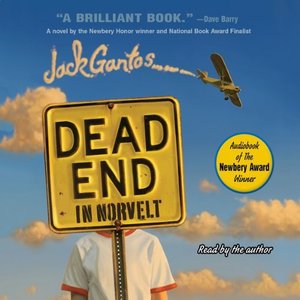
Dead End in Norvelt,

written and read by Jack Gantos

This is a semi-autobiographical historical fiction tale, with a little bit of mystery thrown in. It won the 2012 Scott O’Dell Award for Historical Fiction  as well as the 2012 Newbery Medal.  It’s set in the summer of 1962 in the real town of Norvelt, Pennsylvania. Jack is 12 and has been grounded (partly because he’s caught between the conflicting wishes of his parents), but he’s allowed to help an elderly arthritic neighbor, Miss Volker, to write her obituaries as the original settlers of Norvelt slowly die off.

Sounds rather grim, doesn’t it? But Gantos combines fun fiction with (sometimes crazy) truths (according to the author),  such as spending part of his childhood in Norvelt, Miss Volker’s character (not her real name), his childhood tendency for frequent nosebleeds that “spray out of my nose holes like dragon flames" (page 8), and a dad who had Japanese souvenirs from World War II and won a Piper J-3 Cub airplane in a poker game. This creates a book where, as he explains in a video interview included on one of the audiobook’s CDs, "one of the prime motivations…is this notion that history, our history, is so vastly important."

Norvelt (named for Eleanor Roosevelt) is a real town with an interesting past. According to Miss Volker (page 214-215),

Jefferson believed that every American should have a house on a large enough piece of fertile property so that during hard times, when money was difficult to come by, a man and woman could always grow crops and have enough food to feed their family. Jefferson believed that the farmer was the key to America and that a well-run family farm was a model for a well-run government. Mrs. Roosevelt felt the same. And we in Norvelt keep that belief alive.

In his Newbery Medal acceptance speech (Horn Book Magazine, July/August 2012, page 45), Jack Gantos noted:

The "obit'" is a very tidy literary form and one that Dead End’s Miss Volker generously stretched to also include some meteoric moment in history that intersected with the life of the deceased in order to point out how, in life, we might feel like but a speck of dust on the planet but in truth we are all tied together in one massive hand-holding of humanity—for better or for worse. 

These obituaries, Miss Volker’s “This Day in History” feature in the local newspaper, and Jack’s fondness for Landmark history series books, combined with the comedy and humor, reinforce the message that (as Miss Volker says, page 214), “if you don't know your history you won't know the difference between the truth and wishful thinking," and (as Jack realizes near the end of the book, page 340) “the reason you remind yourself of the stupid stuff you've done in the past is so you don't do it again."

I liked the end of this book (despite its surprise), and I feel it was deserving of the Newbery.  Aimed at students from ages 10-14, grades 5-8, I think it will especially appeal to boys. I found myself wondering as I read it how my son would have reacted, 12-16 years ago.

The audiobook is fantastic! It made me laugh (and sometimes cry). Gantos is perfect as the narrator. His somewhat whiny voice fits a 12-year-old boy. In a Booklist interview, Gantos acknowledged boys’ frequent preference for male readers: “I think there is a sense that if a man is reading the book, then it is entirely cool to sit and listen to it. It’s a man-to-man relationship around a good story. Perhaps it’s like sitting around a campfire and hearing a good tale.” The audiobook makes a good alternative for younger or struggling readers who might have difficulty with its fifth-to-sixth-grade reading level.

© Amanda Pape - 2012

[The audiobook has been purchased for the Dick Smith Library. A print copy is already in circulation, call number PZ7 .G15334 DD 2011.]

Saturday, August 13, 2011

Moon Over Manifest


by Clare Vanderpool,
read by Justine Eyre
with Cassandra Campbell and Kirby Heyborne

This book was most deserving of the 2011 Newbery Medal.  With dual narrative lines set in 1917-1918 and 1936, it's the story of a small town in Kansas called Manifest (modeled after the real town of Frontenac, where author Clare Vanderpool's grandparents grew up).

In her Newbery acceptance speech, Vanderpool stated, "I knew I wanted to write a story about place and about home from the perspective of a young girl who didn’t have a home." (*42)  She later added,
"I came across a quote from Moby Dick. 'It is not down in any map; true places never are.' That’s when the wheels began turning. What is a true place? What would a true place be for someone who had never lived anywhere for more than a few weeks or months at a time? What if it was a young girl during the Depression? A young girl named Abilene Tucker." (*44)

Twelve-year-old Abilene is sent in late May, 1936, to the town of Manifest by her drifter father Gideon, the closest place to a home in her father's stories.  She's supposed to stay with a preacher named Shady.  She arrives just in time for the last day of school, where she meets Ruthanne and Lettie, her playmates for the summer.  She also meets Miss Sadie, a Hungarian woman who runs a "divining parlor."

Throughout the book, Miss Sadie tells Abilene a story about Manifest in 1917-1918, that mysteriously ties in items from a cigar box Abilene found hidden in Shady's home.  The cigar box also contains letters from 1918 from Ned Gillen, a boy adopted by the local hardware store owner from the orphan train.  Ned wrote the letters back to a boy named Jinx, after he helped Ned join the army (underage) to fight in World War I.  Both Jinx and Ned (and Shady and a few other local people still alive in 1936, such as Hattie Mae and Sister Redempta) are in Miss Sadie's stories.

On the audiobook, actress Justine Eyre voices both Abilene in the first person in 1936, and the third-person 1917-1918 stories of Miss Sadie.  Besides these alternating narratives, there are also excerpts from Ned's letters (voiced by Kirby Heyborne) and from "Hattie Mae's News Auxiliary," a column in the local newspaper in both 1917-1918 and in 1936 (read by Cassandra Campbell). 

It all works together to create a novel with an intriguing plot, compelling characters, and a lot of heart and soul.  And Vanderpool does an excellent job in creating her setting, not only in time and place, but also in the details of historical events and community life.  I could feel the heat of the hot, dry summer, but I also felt the excitement of the bootlegging shenanigans, the immigrants' fear of the Klan and the mine owner, and the dread and sadness brought by Spanish influenza.

According to Vanderpool,
"Moon Over Manifest is about home and community, but in many ways it became a story about storytelling and the transformative power of story in our lives....Abilene would call this a universal—this need for story....And of all the places for her to end up in her drifting: Manifest, Kansas, the stopping point for immigrants and refugees from around the world. Displaced people just like her. People with stories of their own but whose stories become hers.... Through the people of Manifest, Abilene experiences the power in a story." (*44-45)
So does the reader. 

This book has an 800 Lexile score and measures at grade 5.3 reading level on Accelerated Reader, with an interest level of grades 4-8.  The main characters are 12 (Abilene and her girlfriends) and 13 (Jinx), at the upper end of that grade range.  With the mystery subplot and Jinx's cons, I think the story would appeal to both boys and girls.  An author's note at the end addresses what's real and what's not in the book, and suggests further reading.  There are plenty of opportunities to tie this book in with lessons on social studies, English language arts, and even science.

(*Vanderpool, Clare. "Newbery Acceptance Speech," The Horn Book Magazine, Volume 87, Issue 4, July-August 2011, pages 39-45.)

© Amanda Pape - 2011 - this review also appears on my blog, Bookin' It.

[This audiobook and a hardbound copy of the book were borrowed from and returned to the Dick Smith Library at Tarleton State University, Stephenville, Texas, where I also accessed Vanderpool's speech through the EBSCO Academic Search Complete database.]

Monday, October 26, 2009

Historical Fiction Picture Books

Just a heads up to you students that so far I have identified only 127 historical fiction picture books in our collection. While I expect to find some more as I go through our picture books one at a time, I wanted to ask you to please be considerate of your fellow classmates while working on this genre. We have about 60 students in Stephenville taking this class, as well as a few students in the Fort Worth and Weatherford classes that use the Dick Smith Library regularly. Rather than checking the books out, please try to use the books on site in the library, or check another library if you have access to one.

Historical fiction at the Dick Smith Library that I've identified so far is listed here:
http://www.librarything.com/catalog/rdg301library&tag=historical%2Bfiction
Please note that this list also includes about 100 chapter books; read the tags carefully.

These books will start going on display on Thursday, October 29. Today I ordered 30 more historical fiction picture books, but unfortunately these won't be in before your assignments are due.

Librarians at school or public libraries should be able to help you find additional historical fiction titles in their collections. Please don't hesitate to ask them (or me) for help!
Amanda Pape
Special Services Librarian II
pape@tarleton.edu
Related Posts Plugin for WordPress, Blogger...