Showing posts with label biography. Show all posts

Sunday, March 1, 2015

2015 Newbery Honor Book

This partial autobiography/memoir in graphic novel format won a much-deserved John Newbery Award Honor Book designation, given "to the author[s] of the most distinguished contribution[s] to American literature for children."

CeCe Bell suffered a severe hearing loss as a result of meningitis at age four.  While she could wear a less conspicuous hearing aid at home, she needed to use a "phonic ear" at school, a rather bulky personal sound amplification system, to best hear the teacher.

Bell, who also did the illustrations (colored by David Lasky), gives her characters rabbit ears and faces, and they remind me of the anthropomorphic characters in Marc Brown's Arthur series -  which, interestingly, came out about the time this book begins, in the late 1970s, when Bell is age four.  The book ends when Bell is in the fifth grade.

The rabbit ears, of course, highlight the issue of hearing.  Empty speech bubbles (when Bell can't hear) and random collections of letters (when she can hear but not understand) emphasize some of the issues she had.  The Phonic Ear and her hearing aid solve some of these, but not when they are broken or have dead batteries.  CeCe learns to lip read at in a kindergarten class with other hearing-impaired children.  The summer following, though, her family moves to a smaller town, and CeCe is in a regular classroom for first grade on.

CeCe struggles to find a best friend who will accept her as she is and not make a big deal of her deafness.  She has her first crush.  She imagines a superhero alter-ego she christens "El Deafo" to help her through the tough times.  All in all, though, this memoir is positive, because CeCe remains upbeat.

An author's note at the end of the book explains that deafness has many causes and degrees - and that deaf people choose different ways to deal with it, ranging from trying to fit in, as CeCe does, with hearing aids and lip reading, to embracing the Deaf community or culture, in which sign language (which CeCe resists learning as a youngster) is the preferred means of  communication.  I loved her conclusion:

I found that with a little creativity, and a lot of dedication, any difference can be turned into something amazing.  Our differences are our superpowers.
Despite the picture-book like illustrations, at 233 pages, this book is probably most appropriate for third through sixth graders.


© Amanda Pape - 2015

[El Deafo is available on the lower level of the Dick Smith Library in the Curriculum Collection, call number EDUC HV2534 .B44 A3 2014 .]

Thursday, February 26, 2015

2015 Schneider Family Book Award Winner


A Boy and a Jaguar is an autobiographical picture book about and by wildlife conservationist Alan Rabinowitz.  In it, he tells how his stuttering as a child led to his passion to protect jaguars and other animals.  This book won the 2015 American Library Association Schneider Family Book Award in the children's category "for a book that embodies an artistic expression of the disability experience for child and adolescent audiences."  Catia Chien's acrylic and charcoal pencil illustrations help the reader feel the enormity of the isolation Rabinowitz sometimes felt as a child, as well as the possibilities of the huge forests and jungles he finds so rewarding as an adult.  Rabinowitz's book will be inspiring for any children who stutter (and their friends, families, and classmates).


© Amanda Pape - 2015

[The call number for A Boy and a Jaguar is QL83 .R33 2014.]

Thursday, September 18, 2014

Spic-and-Span!


Cheaper by the Dozen and its sequel Belles on Their Toes were chapter books about industrial engineers Frank and Lillian Gilbreth and their large family in the early 1900s.  This hardbound picture book biography is about Lillian, a pioneer in her field and an inventor in the area of ergonomics.  She was responsible for the electric mixer, refrigerator compartments, and trash cans with foot pedal lid openers!  The author, Monica Kulling, has written other books in her "Great Ideas" picture book biography series.  David Parkins' pen-and-ink with watercolor illustrations are amusing and add to the story.

© Amanda Pape - 2014

[Spic-and-Span! is available on the lower level of the Dick Smith Library in the Curriculum Collection, call number EDUC T55.85 .G64 K85 2014]

Monday, August 4, 2014

In Search of the Little Prince

Subtitled "The Story of Antoine de Saint-Exupéry," this is a picture book biography about the author of the French classic The Little Prince.

The book was originally published in Italian, as Italy is the home of the author/illustrator, Bimba Landmann.  Her soft illustrations are fanciful yet serious.  There are a number of actual photographs of and quotations from Saint-Exupéry in the book.  The amount of text on each page makes this book more appropriate for grades 3-5.

© Amanda Pape - 2014


[In Search of the Little Prince is available on the lower level of the Dick Smith Library in the Curriculum Collection, call number EDUC PQ2637 .A274 Z748 2014.]

Sunday, May 11, 2014

The Mad Potter

The Mad Potter: George E. Ohr, Eccentric Genius, written by Jan Greenberg and Sandra Jordan, is a 2014 Robert F. Sibert Informational Book Award Honor Book, as one of the most distinguished informational books for children.  It is also an Orbis Pictus Recommended Book for 2014.  The NCTE Orbis Pictus Award  was established in 1989 by the National Council for the Teachers of English for promoting and recognizing excellence in the writing of nonfiction for children.

George Ohr was a ceramics artist ahead of his time.  This 45-page biography is illustrated with period photographs of Ohr, his family, and Biloxi, Mississippi (where he lived), as well as brilliant color images of some of his (very) unusual works.  Various text fonts are also used for some quotes and captions to add further interest.

Due to the length and complexity of the text, the book is more appropriate for grades 4-8.  There is information at the end about the Ohr-O'Keefe Museum in Biloxi, how to evaluate and to make your own pots, and an extensive bibliography, end notes, and photo credits.

Greenberg and Jordan also teamed up on Ballet for Martha, which won the 2011 Orbis Pictus Award and was a Sibert Honor Book that year.

© Amanda Pape - 2014

[The Mad Potter is available on the lower level of the Dick Smith Library in the Curriculum Collection, call number EDUC NK4210 .O42 G74 2013,]

Saturday, May 10, 2014

2014 Schneider Family Book Award Winner

 A Splash of Red: The Life and Art of Horace Pippin, by Jen Bryant, illustrated by Melissa Sweet, won the 2014 Schneider Family Book Award for books for ages up to 10 that "embody an artistic expression of the disability experience."

It was also the 2014 Orbis Pictus winner this year.  The NCTE Orbis Pictus Award was established in 1989 by the National Council for the Teachers of English for promoting and recognizing excellence in the writing of nonfiction for children.  Finally, it was also named a 2014 Robert F. Sibert Informational Book Award Honor Book for one of the most distinguished informational books for children.

This picture book biography (definitely appropriate for ages 6-10) is about African-American self-taught artist Horace Pippin (1888-1946), who painted despite a severe injury to his right arm suffered in World War I.

Bryant and Sweet teamed up on A River of Words, a picture book biography of William Carlos Williams, which was a Caldecott Honor Book in 2009. Bryant was inspired to write about Pippin while researching for another book.  Sweet also wrote and illustrated Balloons Over Broadway, which won the Sibert AND the Orbis Pictus in 2012.  Sweet used watercolor, gouache, and mixed media (including fabric and wood carvings) in her illustrations for A Splash of Red.   She also lettered in many quotes from him among the illustrations.  The book also includes a page of resources (further reading, web sites, etc.), and there is a map on the back end pages showing places you can see Pippin's art, as well as some actual examples of his work.


© Amanda Pape - 2014

[The call number for A Splash of Red is ND237 .P65 B79 2013.]

Tuesday, October 23, 2012

Three Award-Winning Picture Books

Here are three picture books that won Youth Media Awards on January 10, 2011:

The Randolph Caldecott Medal, which "honors the illustrator of the year's most distinguished American picture book for children," went to A Sick Day for Amos McGee, illustrated by Erin E. Stead, and written by her husband Philip C. Stead.  This was Erin's first foray into book illustration.  She used "woodblock printing techniques and pencil" with, in her words, "subtle color and specifically for this book limited palettes," to illustrate this sweet fantasy of a zookeeper and his animal friends.  The soft but detailed drawings are reminiscent of children's book illustrations from my own childhood in the 1960s.  This book was named one of the ten best illustrated children's books for 2010 by the New York Times.  It's a bedtime story appropriate for younger children.

The Coretta Scott King Book Awards "honor African American authors and illustrators of outstanding books for children and young adults that communicate the African American experience."  One Illustrator Honor Book was named in 2011, Jimi Sounds Like a Rainbow: A Story of the Young Jimi Hendrix, illustrated by Javaka Steptoe (daughter of John Steptoe), and written by Gary Golio.  The narrative stops before Hendrix' untimely death, but an afterword and author's note address some of those issues.  There are also a number of websites and books listed about substance abuse as well as about Hendrix, and a selected discography of music and video by and about him.  Steptoe used mixed media, including paint, collage, and silkscreen, and in an illustrator's note, says,
I thought about guitars--their sound, their vibrations, their look and feel--so I used plywood...I thought about how Jimi saw the world and how that differed from other people's views, so I painted Jimi one way and his surroundings another way.  I thought about the depth and texture of his music, so I layered and used bright colors: red, orange, yellow, green, blue, purple--rainbow colors.
The subject matter and complex illustrations make this book more appropriate for older children.  It would appeal to reluctant readers and could be tied into art and music curricula.

The Schneider Family Book Awards "honor an author or illustrator for a book that embodies an artistic expression of the disability experience for child and adolescent audiences."  The 2011 award for children ages 0 to 10 went to The Pirate of Kindergarten, written by George Ella Lyon and illustrated by Lynne Avril.  In this simple yet empathetic story, the main character, Ginny, suffers from double vision, remedied with "exercises, glasses, and for a while, a patch."  She becomes a "Kindergarten Pirate."  The genius of this book is the combination of Lyon's descriptive text and Avril's chalk pastel, mixed with acrylic medium, and colored pencil drawings that let the reader see what Ginny sees - two of everything.  The only wish I have for this book would be for a brief afterword that explains more about double vision (diplopia), patching (used to treat other eye problems too), and author Lyon's "own experience" on which the book is based.  The book is obviously appropriate for kindergarten, but would work for children slightly older and younger as well.  This was my favorite of these three books.

© Amanda Pape - 2012

[These books are available in the Curriculum Collection of the Dick Smith Library.  A variation of this post was previously published at Bookin' It.]

Sunday, October 21, 2012

2011 Sibert Informational Honor Book

This 88-page biography was named a 2011 Robert F. Sibert Informational Honor Book.  The Medal "is awarded annually to the author(s) and illustrator(s) of the most distinguished informational book published in English during the preceding year" by the American Library Association.

It's a very readable account of the life of the Marquis de Lafayette, illustrated with mostly-period paintings, drawings, and documents (but unfortunately, no maps).  As the title indicates, author Russell Freedman focuses mainly on Lafayette's involvement with the American Revolution, but also addresses his early life and his later involvement with the French Revolution.  Freedman ends the book with a time line, source notes, selected bibliography (with commentary), picture credits, and index.  The book made me want to learn even more about Lafayette (and especially his wife Adrienne, who sounds particularly intriguing).  It's an outstanding addition to Freedman's fine repertoire of biography and history.

© Amanda Pape - 2012

[Lafayette and the American Revolution can be found downstairs in the Curriculum Collection (call number EDUC E207 .L2 F86 2010) of the Dick Smith Library.  This review was originally published at Bookin' It.]

Friday, October 19, 2012

The Extraordinary Mark Twain (according to Susy) - fictionalized biography picture book


The Susy of the title of this wonderful picture book fictionalized biography is Olivia Susan "Susy" Clemens (1872-1896), the oldest daughter of Samuel Clemens, aka Mark Twain.  When she was 13, Susy started writing a biography of her father, because she was "annoyed" that "so few people know Papa, I mean really know him....They think of Mark Twain as a humorist, joking at everything."

Susy's mother later found the biography and shared it with her husband, who expressed "deep pleasure" at her "frequently desperate" spelling and the way she didn't "cover up one's deficiencies, but gave them an equal showing with one's handsomer qualities."  And that's just what Kerley and Fotheringham do in the 19 double-page spreads of the narrative.

Eleven of those spreads feature a small four-page "Journal" glued in by its left side on the right-hand page near the gutter, as pictured below, making small books within the book::
These "journals" contain actual quotations, misspellings and all, from Susy's biography.

Author Barbara Kerley, in an I.N.K. (Interesting Nonfiction for Kids) group blog post, said "I knew when I stumbled across Susy’s diary that it would be a rich counterpart to Twain’s own ‘polished up’ version of his life’s story."

Later, Twain quoted extensively from Susy's biography (retaining the misspellings) in his own Chapters from My Autobiography series for the North American Review, describing Susy as "a frank biographer and an honest one; she uses no sandpaper on me," who was "loyal to the responsibilities of her position as historian."

This is all the more poignant when you read, in the author's note at the end of the book, that Susy died at age 24 of spinal meningitis.  The end of the book also includes a selected timeline of Twain's life and detail on the sources used for each spread of the book.  Kerley also includes an excellent tip sheet on writing a biography appropriate for students, which is also available on the author's web site.

As you can see, the digital media illustrations are marvelous.  The people are (appropriately) cartoon-like, to fit Twain's humor, or shown in silhouette, in color schemes fitting the period.  Edwin Fotheringham even works in an 1890 photograph of Twain and Susy near the end of the book.

I can't recommend The Extraordinary Mark Twain (according to Susy) enough, and I'll be looking for more by Kerley and Fotheringham.

© Amanda Pape - 2012

[This book was borrowed from and returned to the Dick Smith Library at Tarleton State University. It's downstairs in the Curriculum Collection, call number EDUC PZ7 .K4575 EXT 2010.  A version of this review also appears on my blog, Bookin' It.]

Monday, October 15, 2012

2012 Newbery Medalist

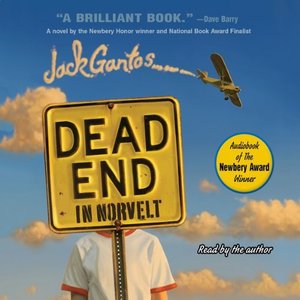
Dead End in Norvelt,

written and read by Jack Gantos

This is a semi-autobiographical historical fiction tale, with a little bit of mystery thrown in. It won the 2012 Scott O’Dell Award for Historical Fiction  as well as the 2012 Newbery Medal.  It’s set in the summer of 1962 in the real town of Norvelt, Pennsylvania. Jack is 12 and has been grounded (partly because he’s caught between the conflicting wishes of his parents), but he’s allowed to help an elderly arthritic neighbor, Miss Volker, to write her obituaries as the original settlers of Norvelt slowly die off.

Sounds rather grim, doesn’t it? But Gantos combines fun fiction with (sometimes crazy) truths (according to the author),  such as spending part of his childhood in Norvelt, Miss Volker’s character (not her real name), his childhood tendency for frequent nosebleeds that “spray out of my nose holes like dragon flames" (page 8), and a dad who had Japanese souvenirs from World War II and won a Piper J-3 Cub airplane in a poker game. This creates a book where, as he explains in a video interview included on one of the audiobook’s CDs, "one of the prime motivations…is this notion that history, our history, is so vastly important."

Norvelt (named for Eleanor Roosevelt) is a real town with an interesting past. According to Miss Volker (page 214-215),

Jefferson believed that every American should have a house on a large enough piece of fertile property so that during hard times, when money was difficult to come by, a man and woman could always grow crops and have enough food to feed their family. Jefferson believed that the farmer was the key to America and that a well-run family farm was a model for a well-run government. Mrs. Roosevelt felt the same. And we in Norvelt keep that belief alive.

In his Newbery Medal acceptance speech (Horn Book Magazine, July/August 2012, page 45), Jack Gantos noted:

The "obit'" is a very tidy literary form and one that Dead End’s Miss Volker generously stretched to also include some meteoric moment in history that intersected with the life of the deceased in order to point out how, in life, we might feel like but a speck of dust on the planet but in truth we are all tied together in one massive hand-holding of humanity—for better or for worse. 

These obituaries, Miss Volker’s “This Day in History” feature in the local newspaper, and Jack’s fondness for Landmark history series books, combined with the comedy and humor, reinforce the message that (as Miss Volker says, page 214), “if you don't know your history you won't know the difference between the truth and wishful thinking," and (as Jack realizes near the end of the book, page 340) “the reason you remind yourself of the stupid stuff you've done in the past is so you don't do it again."

I liked the end of this book (despite its surprise), and I feel it was deserving of the Newbery.  Aimed at students from ages 10-14, grades 5-8, I think it will especially appeal to boys. I found myself wondering as I read it how my son would have reacted, 12-16 years ago.

The audiobook is fantastic! It made me laugh (and sometimes cry). Gantos is perfect as the narrator. His somewhat whiny voice fits a 12-year-old boy. In a Booklist interview, Gantos acknowledged boys’ frequent preference for male readers: “I think there is a sense that if a man is reading the book, then it is entirely cool to sit and listen to it. It’s a man-to-man relationship around a good story. Perhaps it’s like sitting around a campfire and hearing a good tale.” The audiobook makes a good alternative for younger or struggling readers who might have difficulty with its fifth-to-sixth-grade reading level.

© Amanda Pape - 2012

[The audiobook has been purchased for the Dick Smith Library. A print copy is already in circulation, call number PZ7 .G15334 DD 2011.]

Monday, February 20, 2012

2012 Sibert Winners

Here are two books that were named by the American Library Association on January 23 as the winner and an honor book respectively of the Robert F. Sibert Informational Book Medal for "the most distinguished informational book published in the United States in English during the preceding year."

Balloons Over Broadway by Melissa Sweet is about its subtitle:  "The True Story of the Puppeteer of Macy's Parade," immigrant Tony Sarg (1882-1942).  With her trademark 3D collages, gouache, and mixed media including period photographs, Sweet brings to life the little-known man behind the giant balloon puppets at the New York City Macy's Thanksgiving Day Parade beginning in 1927 (as well as Macy's famous "Wondertown" display windows).

This is a fun book with an author's note providing more information about Sarg at the end, as well as a bibliography and source list.  This book was also honored in 2012 with the Orbis Pictus Award "for Outstanding Nonfiction for Children" from the National Council of Teachers of English, and as a 2012 Zolotow Award Highly Commended Book, an award "given annually to the author of the best picture book text published in the United States in the preceding year" by the Cooperative Children's Book Center.  This book has a fifth-grade reading level, so it is probably most appropriate as a read-aloud for younger children, but older kids will get a kick out of it as well.

I'm not too crazy about the cover of Caldecott Medalist (in 1994, with an Honor book in 1988) Allen's Say's partial autobiography in graphic novel form, Drawing from Memory.  It doesn't really invite one to explore the fabulous pictures and story inside. Say used watercolors, pen and ink, pencils, and photographs to tell the story of his unusual childhood, particularly his teen years in post-World War II Japan.  At the age of 12, Say was living independently and apprenticed himself to master cartoonist Noro Shinpei.  The book ends four years later, in the summer of 1953, when Say decides to take up his estranged father's offer and join his new family in the United States.

Say's life story after that point is also intriguing, and one would have to know it to appreciate the irony of a statement he makes on page 50, "I hated photography."  Say also disliked his father, made clear in the book with only one drawing that includes him - back turned, hands on hips.  In contrast, the book is a tribute to Shinpei, who also served as a father figure to Say, and there is an extensive author's note at the end with many photographs of Shinpei and his family.

Say wrote an autobiographical novel in 1979, The Ink-Keeper's Apprentice, that covered much of  the same material, but this book is probably more accessible.  Its 63 pages and numerous illustrations, many in comic book format, combined with a reading level of about fourth grade, makes it appealing to reluctant readers, as the book would interest students up through high school. 

© Amanda Pape - 2012

[These books have been purchased for the Dick Smith Library.]

Monday, February 13, 2012

2012 Caldecott Winners

Here are the four books that were honored by the American Library Association on January 23 as the Caldecott Medalist and Honor Books, awards given to the illustrators of the most distinguished American picture books for children:
A Ball for Daisy, written and illustrated by Chris Raschka, took the Medal. A wordless book, the story is conveyed through Raschka's simple, almost child-like paintings in watercolor, gouache and ink.  A dog loses her favorite red ball when a poodle steals it and it bursts.  She's down and depressed until a later visit to the park when the poodle's owner gives her a new blue ball.

In an interview, Raschka said the book was inspired by his son at age 4, who was devastated when his yellow ball broke during a quarrel with a neighbor. The author said he began thinking of "those first feelings of losing something beloved" and knowing you can't get it back. For the story, he changed the main character from a boy to a dog.  "When you're a picture book illustrator, your readers are often three or four years old, and you don't want the drawing to be upsetting in itself.  By having an animal, there's some distance, and yet there is still a connection."

I think ages 3-5 is about the right target for this book.  It could also be used with older children to encourage them to tell or write a story to go along with the illustrations.

This is Raschka's second Caldecott Medal; he won in 2006 for illustrating Norton Juster's The Hello, Goodbye Window, and his Yo! Yes? was a Caldecott Honor book in 1994.  Raschka is the 2012 USA nominee for illustration for the Hans Christian Andersen Award.

Three Honor books were also named. Blackout was written and illustrated by John Rocco, who is also the illustrator of the dust jackets of Rick Riordan's fantasy novel series such as Percy Jackson and the Olympians, and the Kane Chronicles.  Rocco has an interesting background as an art director on the movie Shrek and a designer of Disney theme park rides.

Blackout tells of a busy family's experiences during a power outage one evening. His colorful cartoon-like illustrations bring out the fun and magic in the situation.  He makes especially good use of silhouettes and the lights and shadows created by candles, flashlights, and stars.  It's a story I think a lot of us can relate to, being forced to "unplug" from our wired, always-connected lives for an evening.

Rocco set his story in his home of Brooklyn and interviewed people in New York City about their experiences in the big August 2003 blackout there.

This book has a Lexile measure of 0, due to the fact it has very few words. It is designated as a beginning reader, so it's probably best for ages 4-7.  It's also appropriate as a read-aloud, with its page-filling illustrations.

Grandpa Green by Lane Smith also took a Caldecott Honor. A little boy wanders through a fanciful garden of topiaries created by his great-grandfather that evoke memories of the latter's life.

The whimsical illustrations were created using watercolor, oil paint, and digital paint for the foliage, and brush with waterproof drawing ink for the characters.  This is a very different style from Smith's other books, but it works perfectly with this story.

I loved the subtle message about valuing our seniors for what they remember rather than what they forget, as the little boy collects the tools and accessories his great-grandpa gardener has left behind.  Young children may not get that message, but the parents (and grandparents, and great-grandparents) reading the book to them will, and all will enjoy the little details in the illustrations.  The book's reading level is about second grade.

Smith also received a Caldecott Honor in 1993 for illustrating (his frequent cohort) Jon Scieszka's The Stinky Cheese Man and Other Fairly Stupid Tales.

The final Caldecott Honor went to Patrick McDonnell's Me...Jane.  This is a picture book biography about primatologist Jane Goodall's childhood.  McDonnell is on the board of directors of the Humane Society of the United States and active in animal welfare work, so this homage to Goodall is fitting.

McDonnell does the comic strip Mutts, and his India ink and watercolor illustrations in this book reflect that style.  Except for double-page-spread illustrations (of young Jane and her ever-present stuffed toy chimpanzee named Jubilee), these drawings fall on the right-hand page, with the text on the left.  The text is overlaid on beautiful, muted ornamental engravings from the 1800s and early 1900s, "evoking Jane's lifelong passion for detailed, scientific observation of nature," according to the art notes at the end of the book.

McDonnell has also included photographs of Jane, as well as some of Jane's own sketches, including a double-page spread "of drawings and puzzles that Jane herself created" as a young girl leading a nature club called the Aligator (sic) Society.  End notes also include an "About Jane" section and "A Message from Jane."  The book's clever title is inspired by Jane's love of the Tarzan books as a child.

This book also won the 2012 Charlotte Zolotow Award "for outstanding writing in a picture book," and was named a 2012 Orbis Pictus Recommended Nonfiction Book for Children by the National Council of Teachers of English. With a third grade reading level, this book would be a good starting point for students even up to third- and fourth-grade to learn more about this famous researcher and her work.

© Amanda Pape - 2012

[These books have been purchased for the Dick Smith Library.]
Related Posts Plugin for WordPress, Blogger...